“Education is not a preparation for life; education is life itself.” These were the words of John Dewey, that made me think not just as a teacher, but as a person who believes that learning is more than content, more than grades, more than future goals. For me, education is a present and living experience it is a journey where life and learning intertwine every single day. Over the years, I’ve come to see that real education isn’t about preparing students for some distant future. It’s about awakening them to who they are now, what they think, what they feel, what they believe, and how they can begin shaping the world around them. As a physics teacher, I am committed to more than just teaching formulas or laws like Newton’s laws of motion or the principles of thermodynamics. I want my students to experience interconnectedness that physics reveals about our universe. Just as energy flows and transforms from one form to another, learning for me is a dynamic process. It’s the energy that moves between teacher and student, mind and heart, curiosity and understanding. In a time when so many students are caught up in the pressures of performance and standardization, I strive to create a classroom where learning is filled with meaning, purpose, and connection.
Living the Learning: What I Believe About Real Education
To me, when we say education is life, we commit to engaging the whole person, the mind, the heart, and the soul. This is my existentialist approach to teaching, because it challenges both me and my students to confront the questions that really matter:
Who am I? Why am I here? What do I stand for? Why am I studying this?
But I don’t want these questions to stay in the abstract. That’s why I also hold onto a pragmatic philosophy of education. If learning doesn’t lead to action or if it doesn’t change how we live, serve, or relate to others then it remains incomplete. In my classroom, I don’t just want students to memorize equations; I want them to feel the excitement of learning by doing. The enthusiasm of realizing that the laws of physics aren’t just abstract concepts, but lenses through which they can understand their own actions like throwing a basketball and predicting it’s trajectory, the resonance of a guitar string, or the thermodynamics of their own energy and motivation. The union of existentialism and pragmatism in my teaching creates a space where deep thinking meets real-world impact. I want them to discover the parallels between the principles of momentum and the its connection to safety features in car.
Teaching Through Dialogue: A Shared Human Experience journey
One of the most powerful shifts I’ve made in my teaching came when I embraced dialogic problem-posing education, inspired by Paulo Freire. I stopped seeing myself as the expert at the front of the room, and started seeing myself as a co-learner, co-investigator, and co-explorer with my students. Instead of giving answers, I started asking better questions. I began to pose problems that are rooted in real-life such as personal, social, and ethical issues and invited students to explore them with me. When I pose these problems, the classroom becomes more than a place to prepare for exams. It becomes a laboratory for life itself. We were practicing how to live, how to listen, question, empathize, and imagine a more just and compassionate world. This approach has not only made my classroom more alive but it has made it more human.
Why I Teach: A Calling Fueled by Faith and Passion
For me, teaching is more than just a profession. It’s a calling like a profound force that moves me with the same power and inevitability as gravity itself. One grounded in both passion and faith. I believe that every student I encounter is uniquely created, deeply valuable, and full of untapped potential like particles waiting to be discovered and understood. My faith is my fuel to teach with integrity and love, even when it’s hard. It reminds me that every moment in the classroom is part of something bigger than myself.
When I innovate, it’s not just for engagement’s sake nor to capture their attention, but because each student deserves a learning experience one that stirs their curiosity. When I listen deeply to my students, it’s because their voices matter and carry the potential to create their own path. And when I model purpose and honesty, it’s because I want my life, not just my lessons, to be a witness to truth. A living curriculum, where values aren’t just abstract concepts to be learned, but lived realities.
Education as a Sacred Act of Living
To say that education is life itself is to recognize that every class period, every dialogue, every challenge is an opportunity for transformation. I don’t teach just for grades or outcomes. I teach for formation over information, for purpose over performance, and for transformation over transaction. In my classroom, I hope students don’t just prepare for life but rather they begin to experience it fully. I hope they leave not just smarter, but more awake, more courageous, more compassionate. Because ultimately, education isn’t a rehearsal. It’s not the warm-up. It is life. And we are living it together.
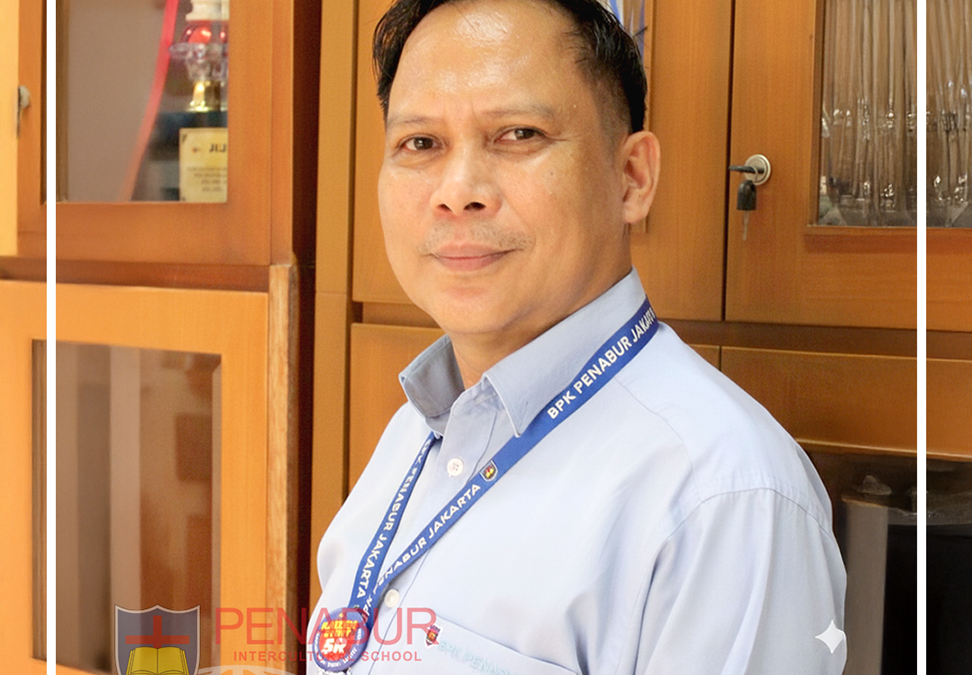
Author: Tessier Rey M. Billena,
Teacher,
PENABUR Intercultural School Secondary & Junior College Tanjung Duren